

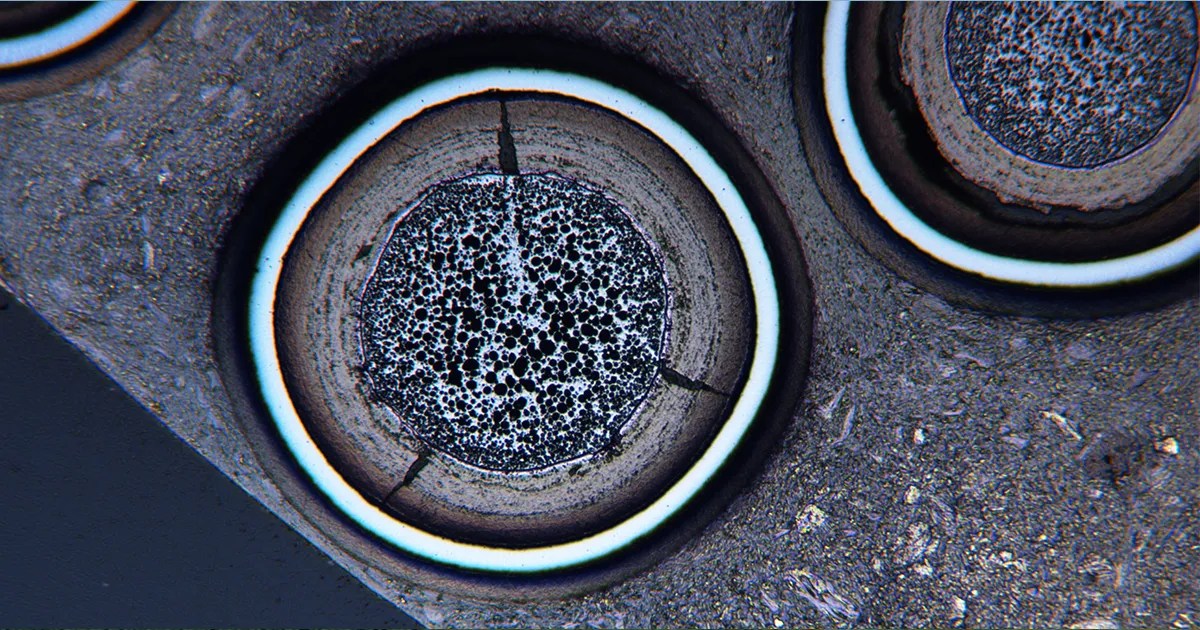
TRISO: the fuel powering our next-gen nuclear reactors
Image Credit: U.S. Department of Energy. (2019). TRISO Particle [Photograph]. Energy.gov. https://www.energy.gov/ne/articles/triso-particles-most-robust-nuclear-fuel-earth
As energy demand continues to increase, researchers remain on the hunt for safer, more efficient ways to generate nuclear power. Many of these advanced conceptual reactors seek to operate at much higher temperatures than reactors today, which will require sturdier fuel.
One promising candidate is tri-structural isotropic (or TRISO) fuel. This fuel form is robust, safe, and flexible—and it’s almost ready for commercial use. Let’s take a look at why so many advanced conceptual reactors hope to use TRISO fuel.
TRISO fuel’s design
TRISO fuel was originally formulated for the UK’s Dragon reactor in the 1960s. This offers it a key advantage over other experimental fuel types—it’s been studied and developed for over 60 years. Its impressive age means that the few remaining unknowns surround its production, use in specific reactors, and disposal, instead of its functionality or safety.

Image Credit: U.S. NRC. (2022). Triso Fuel [Diagram]. NRC.gov. https://www.nrc.gov/reactors/new-reactors/advanced/rulemaking-and-guidance/fuel-qualification/triso-fuel.html
TRISO fuel takes the form of tiny particles of fissile fuel surrounded by several protective layers. The first two layers are carbon, and they accommodate swelling from gaseous fission products and prevent them from escaping. The third layer is silicon carbide, which acts as the main structural element of the particle and a barrier to all fission products. The last pyrolytic carbon layer protects the layers underneath.
It’s also this outer layer that enables the particle to bond to its final graphite matrix. Many thousands of these tiny fuel particles are pressed together in graphite compacts, forming either spherical pebbles or various three-dimensional shapes, depending on the needs of the reactor.
The advantages of TRISO fuel
This combination of layers and flexible graphite fuel form offers impressive benefits. TRISO fuels are “structurally more resistant to neutron irradiation, corrosion, oxidation, and high temperatures (the factors that most impact fuel performance)”, and have an operational lifetime three times longer than that of traditional fuel (Office of Nuclear Energy).
TRISO particles can also handle impressive temperatures when compared to conventional fuel rods. In a test at Idaho National Laboratory, TRISO fuel was irradiated for three years and then subjected to temperatures up to 1800°C—well above the highest temperatures the fuel might reach in a reactor, even in the worst of meltdowns. Even under these extreme conditions, the particles retained their integrity and released none of their fission products.
These properties not only allow reactors using TRISO fuel to operate at higher temperatures and generate power more efficiently, but also make them safer and less costly than other fuel alternatives—and its variable form factor makes it a great candidate for microreactors.
TRISO fuel production today
Unlike many other experimental fuels, TRISO particles are currently being manufactured in several locations, including some commercial facilities.
At their Lynchburg, VA facility, BWXT has been producing TRISO fuel for the scientific community for years. In December 2022, they announced their plans to manufacture a TRISO core for the experimental, portable Project Pele microreactor. BWXT will work alongside the experienced staff of the Idaho National Laboratory to produce this fuel, and they plan to continue their work on TRISO fuels with the DoE, DoD, and NASA.
Multiple TRISO facilities are springing up in the industrial parks of Oak Ridge, TN, thanks to the nearby Oak Ridge National Laboratory. In April of 2022, X-energy announced their plans to construct their TRISO-X Fuel Fabrication Facility, the nation’s first in high-assay low-enriched uranium fuel production.
In August of the same year, Ultra Safe Nuclear Corporation opened its own Pilot Fuel Manufacturing Facility (PFM) in Oak Ridge’s East Tennessee Technology Park, planning to produce TRISO fuel for testing and qualification in advanced microreactors.
In January of 2023, Ultra Safe Nuclear Corporation signed an agreement with French nuclear company Framatome to produce TRISO fuels for commercial use at their PFM facility. This will be the first fully privately funded production of TRISO fuel in the USA.
Reactors of the future
While dozens of advanced reactor concepts hope to use the TRISO fuel that is now being commercially produced, only a few are slated for testing in the next decade.
X-energy is working to develop both the Xe-100 and the Xe-Mobile. The Xe-100 is a modular reactor that runs on TRISO pebbles, featuring 76 megawatts of power, a 60-year operational life, online refueling, and an impressively tiny 400-meter safety perimeter thanks to the fact that it can’t melt down. It’s expected to be available as early as the late 2020s. The Xe-Mobile is still under development, but aims to provide a highly safe, portable source of emergency power.
The Ultra Safe Nuclear Corporation is also developing a TRISO reactor of its own. Called the Micro Modular Reactor (MMR), this small reactor can provide 5-10 megawatts of power (or 15-30 megawatts of thermal power), and it’s modular, allowing each individual reactor to be powered on as grid use requires. Demonstration units are scheduled to come online in 2026, and the company has already established an order book for first users.
Many other reactors that use TRISO fuel, like Kairos Power’s FHR reactor, are under development—but commercial operation of reactors like these won’t begin until after 2030.
Obstacles to TRISO reactors
As promising as they are, these advanced reactor concepts and their TRISO fuel will have obstacles to surmount beyond just their development.
Despite what marketing may claim, TRISO fuels aren’t perfectly stable. While they still offer a much higher degree of containment than any conventional fuel, recent research has shown it is still possible for a particle to fail, usually as a result of damage to its layers from overpressure, de-bonding, or degradation.
Although these failures are usually manufacturing defects that are limited to around 1 in 100,000 particles, they still warrant further investigation. Only around 1 million TRISO particles have been rigorously studied in this way, and around 1 billion would be required for a single 200-megawatt reactor—there’s still plenty of qualification to do.
The management of TRISO waste is also still being studied, despite its excellent ability to contain fission products. If the TRISO particles aren’t separated from their graphite matrix, vast amounts of waste are generated, which complicates disposal. Extraction methods like crushing and combustion leave behind problematic waste, and safer methods like electrochemical processing are still under development.
Additionally, TRISO particles need to undergo more research to be directly disposed of without further containment. It’s still unknown how they may behave in geological repositories, and whether the carbon and silicon carbide layers surrounding the fission products will maintain their integrity over time after their long-term radiation exposure.
The bottom line
Although TRISO fuel isn’t a fully mature technology, it’s one with a lot of promise. Commercial production of this fuel is already beginning in the USA, and thanks to its impressive durability, safety, and efficiency, it’s the choice of many high-temperature and microreactor concepts of the future.
References
Expand
1. American Nuclear Society. (2013, November). Triso fuel development progresses at INL, ORNL. Retrieved March 3, 2023, from https://www.gen-4.org/gif/upload/docs/application/pdf/2014-03/nov13nn_fuel_reprint.pdf
2. BWXT Starts Production of TRISO Fuel for First U.S. Generation IV Microreactor. BWX Technologies, Inc. (2022, December 7). Retrieved March 3, 2023, from https://www.bwxt.com/news/2022/12/07/BWXT-Starts-Production-of-TRISO-Fuel-for-First-US-Generation-IV-Microreactor
3. Fuks, L., Herdzik-Koniecko, I., Kiegiel, K., & Zakrzewska-Koltuniewicz, G. (2020). Management of radioactive waste containing graphite: Overview of methods. Energies, 13(18), 4638. https://doi.org/10.3390/en13184638
4. Kairos Power. (2020, October 30). Technology – How It Works. Kairos Power. Retrieved March 3, 2023, from https://kairospower.com/technology/
5. Office of Nuclear Energy. (2019, July 9). TRISO particles: The most robust nuclear fuel on Earth. Energy.gov. Retrieved March 3, 2023, from https://www.energy.gov/ne/articles/triso-particles-most-robust-nuclear-fuel-earth
6. Office of Nuclear Energy. (2021, January 5). X-energy is developing a pebble bed reactor that they say can’t melt down. Energy.gov. Retrieved March 3, 2023, from https://www.energy.gov/ne/articles/x-energy-developing-pebble-bed-reactor-they-say-cant-melt-down
7. Simon, R. A., & Capp, P. D. (n.d.). Operating experience with the Dragon high temperature reactor – IAEA. Retrieved March 3, 2023, from https://inis.iaea.org/collection/NCLCollectionStore/_Public/33/033/33033056.pdf?r=1&r=1
8. Ultra Safe Nuclear Corporation. (2022, August 19). Ultra Safe Nuclear Corporation announces the opening of pilot fuel manufacturing facility in Oak Ridge, Tenn.. Ultra Safe Nuclear. Retrieved March 3, 2023, from https://www.usnc.com/ultra-safe-nuclear-corporation-announces-the-opening-of-pilot-fuel-manufacturing-facility-in-oak-ridge-tenn/
9. Ultra Safe Nuclear Corporation. (2022, September 25). Micro Modular Reactor – Advanced Nuclear HTGR. Ultra Safe Nuclear. Retrieved March 3, 2023, from https://www.usnc.com/mmr/
10. Wells, B. E., Phillips, N. R., & Geelhood, K. J. (2021, June). TRISO Fuel: Properties and Failure Modes. Pacific Northwest National Laboratory. Retrieved March 3, 2023, from https://www.nrc.gov/docs/ML2117/ML21175A152.pdf
11. World Nuclear News. (2023, January 27). Companies pool resources to manufacture Triso Fuel. World Nuclear News. Retrieved March 3, 2023, from https://www.world-nuclear-news.org/Articles/Companies-pool-resources-to-manufacture-TRISO-fuel
12. X-energy. (2022, April 4). X-energy’s TRISO-X Selects Oak Ridge Horizon Center for First Commercial Advanced Reactor Fuel Fabrication Facility in North America. X-energy. Retrieved March 3, 2023, from https://www.nrc.gov/docs/ML2210/ML22108A284.pdf
13. X-energy. (n.d.). Reactor: Xe-100 – X-energy: HTGR: Nuclear reactors (SMR) & Triso Fuel. X-energy. Retrieved March 3, 2023, from https://x-energy.com/reactors/xe-100
14. X-energy. (n.d.). Reactor: Xe-Mobile – X-energy: HTGR: Nuclear reactors (SMR) & Triso Fuel. X-energy. Retrieved March 3, 2023, from https://x-energy.com/reactors/xe-mobile
 Thomas Praisner—Freelance Writer